












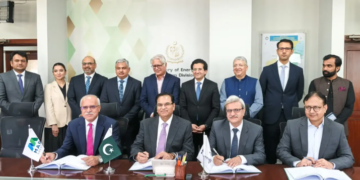
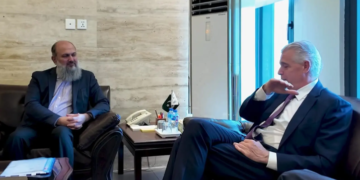

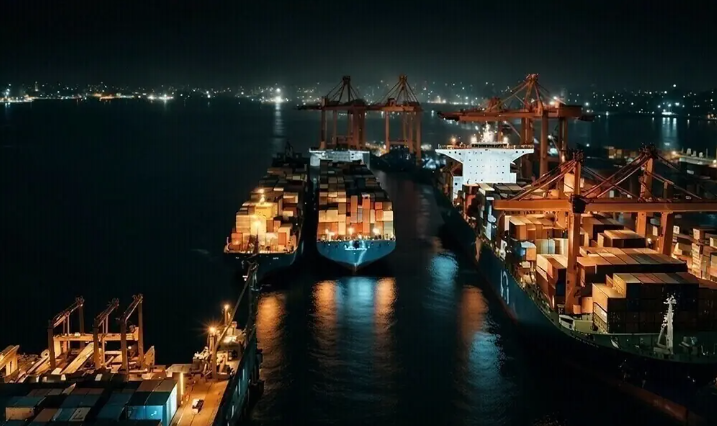
ISLAMABAD: The National Assembly of Pakistan Standing Committee on Commerce on Monday decided to seek comprehensive briefings from the Ministry of Defence, Ministry of Interior, Ministry of Foreign Affairs and the State Bank of Pakistan (SBP) over the persistent decline and stagnation in exports to regional markets.

The committee, chaired by Jawed Hanif Khan, reached the decision while taking up a Calling Attention Notice moved by Aliya Kamran. She asked the Commerce Ministry delegation, led by Special Secretary Syed Hamid Ali, to identify any country where Pakistan’s exports had recorded growth.
She noted that despite improved ties with neighbouring states, trade volumes remain either negligible or non-existent. She questioned the steps taken by the Commerce Ministry to boost exports and asked how the government intends to achieve its $60 billion export target when shipments have hovered between $25–30 billion for nearly two decades.
Other members voiced similar concerns over the lack of meaningful export growth.
The chairman observed that trade with neighbouring countries appears to be overshadowed by security considerations and proposed inviting relevant authorities, headed by the Defence Minister, for a detailed in-camera briefing.
The Special Secretary Commerce suggested also calling the Ministry of Foreign Affairs, Ministry of Interior and the SBP, citing their role in regional trade matters. The committee agreed to summon representatives from all relevant institutions.
The panel also sought a detailed report on the proposed Quetta Expo Centre, with some members pointing out that the selected site is considered a “no-go area.” They stressed that no development project should be undertaken in a high-security-risk zone.
Although the Central Development Working Party (CDWP) has approved the project at an estimated cost exceeding Rs 4.629 billion, funds have yet to be released.
A Planning Ministry official expressed reservations, prompting the committee to link approval of the Rs 3 billion export acceleration initiative for SMEs to clearance from the Ministry of Planning, Development and Special Initiatives.
The Special Secretary Commerce highlighted delays in fund releases for both new and ongoing projects and requested that the Planning Ministry be invited to present its position.
The Planning Ministry representative maintained that the Public Sector Development Programme (PSDP) allocation for 2025–26 stands at Rs 1,000 billion, with disbursements made according to priority.
The committee endorsed the Commerce Ministry’s decision to allocate Rs 15 billion in support to rice exporters to facilitate roughly $1 billion in rice exports, amid intensified competition after India re-entered global markets with accumulated stocks.
Director General Muhammad Ashraf informed the committee that the Export Development Fund (EDF) Board was told rice exports have declined by around 50%, while the overall export drop amounts to $1.4 billion nearly 60% of which is linked to the rice sector.
He said global oversupply, driven by India’s subsidized exports following the lifting of restrictions, has pressured prices and widened the global price differential. The Chairman of REAP sought financial backing from the EDF Board to help Pakistani exporters remain competitive.
The EDF Board approved the Rs 15 billion package in its January 19, 2026 meeting. The Ministry of Commerce issued a notification on January 23, 2026, covering shipments made from that date through June 30, 2026.
Under the notification, drawback claims will be processed only for shipments with fully realized export proceeds.
Standard Operating Procedures were developed in coordination with the Finance Division, AGPR, Pakistan Single Window (PSW) and Customs. The scheme will be digitally administered by PSW in collaboration with the SBP, Customs, FTO and CGA. The EDF has sought Rs 3 billion from the Finance Division to initiate implementation.
The committee also agreed to issue a letter of appreciation to the Director General for delivering a clear and comprehensive presentation.
According to an official statement, members raised alarm over longstanding structural weaknesses in Pakistan’s export framework that have persisted for nearly two decades, citing issues such as limited domestic production, import dependence, high business costs, taxation, provincial levies, and energy and foreign exchange constraints.
Alternative trade partnerships were also discussed in light of regional shifts and the departure of multinational firms.
The chairman underscored the need for holistic planning, stronger inter-ministerial coordination and in-camera briefings by the Ministries of Defence and Foreign Affairs and the SBP to enable informed policymaking on trade and security.
The committee reviewed two major PSDP initiatives the Expo Centre Quetta and the Export Accelerator for SMEs raising concerns about cost overruns, delays, relocation, lack of provincial coordination and accountability gaps.
While the Commerce Ministry sought an additional Rs 3 billion, Planning advised that funding be managed within existing allocations or through project-specific approvals.
On the SME Export Accelerator, members emphasized measurable outcomes, firm financial commitments and close coordination among ministries for effective execution.
The committee also examined the performance and board composition of NICL, acknowledging strong results over the past three years and real estate assets worth Rs 25 billion, including six Dubai units valued at Rs 4.6 billion. Investment ceilings, portfolio diversification and risk coverage were discussed, alongside PRCL’s mandate and strategy ahead of its planned privatization.
Pakistan’s gem and jewellery sector also came under review, with members noting estimated reserves of $450 billion and exports of Swat emeralds and tamerline. Challenges such as illegal gold exports and the absence of hallmarking were highlighted.
Proposals for establishing a regulatory body, export promotion centres and adopting international best practices were presented to ensure sustainability and independent management of the sector.
The chairman directed the Commerce Ministry to assess these proposals in light of existing policies and submit recommendations.
Concerns were also raised over value addition requirements and SRO 760 affecting gold and gemstone exports. Members stressed improved coordination between the Commerce Ministry and the SBP to address remittance and regulatory hurdles.
The chairman instructed that all stakeholders be consulted and that senior SBP officials present concrete proposals at the next meeting.
The committee emphasized timely implementation, financial transparency and inter-governmental coordination to strengthen exports, generate employment and ensure sustainable economic growth.
The meeting was attended by several MNAs, both in person and virtually, along with senior officials from the Ministries of Commerce, Law & Justice, Finance, Planning, Development and Special Initiatives, and the National Assembly Secretariat.