























TOKYO, (Reuters): Japanese stocks swept to all-time peaks while super-long bonds quickly reversed early weakness in an apparent vote of confidence in Prime Minister Sanae Takaichi’s “responsible, proactive” fiscal policy.

The yen initially declined to a record trough against the Swiss franc, but rapidly switched direction after a warning about potential currency intervention from Tokyo.
Takaichi’s Liberal Democratic Party won a landslide 316 of the 465 seats in parliament’s lower house in Sunday’s snap election, giving her a solid mandate to push through big spending and promised tax relief.
But she has repeatedly stressed that her stimulus plans will not blow out the nation’s finances, a major concern for markets given Japan already has the developed world’s heaviest debt burden.
“The result reduces political uncertainty and strengthens the broader ‘Japan is Back’ narrative,” said Masahiko Loo, senior fixed-income strategist at State Street.
“Investor focus is broadening beyond initial ‘Takaichi trade’ winners such as exporters, cyclicals, financials and defence.”
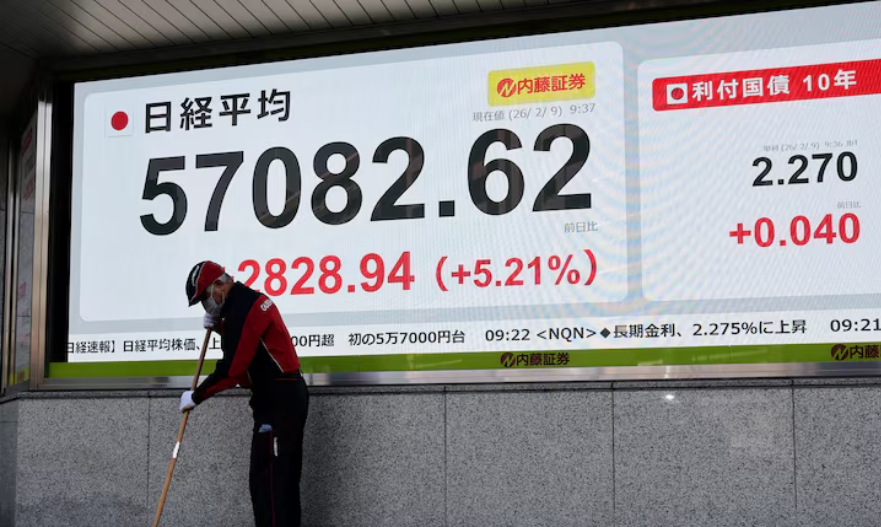
The Nikkei 225 share average, finished the day up 3.9% to notch a record-high close at 56,363.94. The broader Topix, rose 2.3% for a record closing level of 3,783.57.
A GOVERNMENT FOR THE LONG HAUL
“It’s not just a stable administration – What’s coming into view is the prospect of a long-term administration,” said Shingo Ide, chief equity strategist at NLI Research Institute.
For the Nikkei though, “I don’t think it will keep rising at this pace. If it were to shoot straight to 60,000, that would be a bit overdone,” Ide said, adding that it may eventually “settle down” around 56,000.
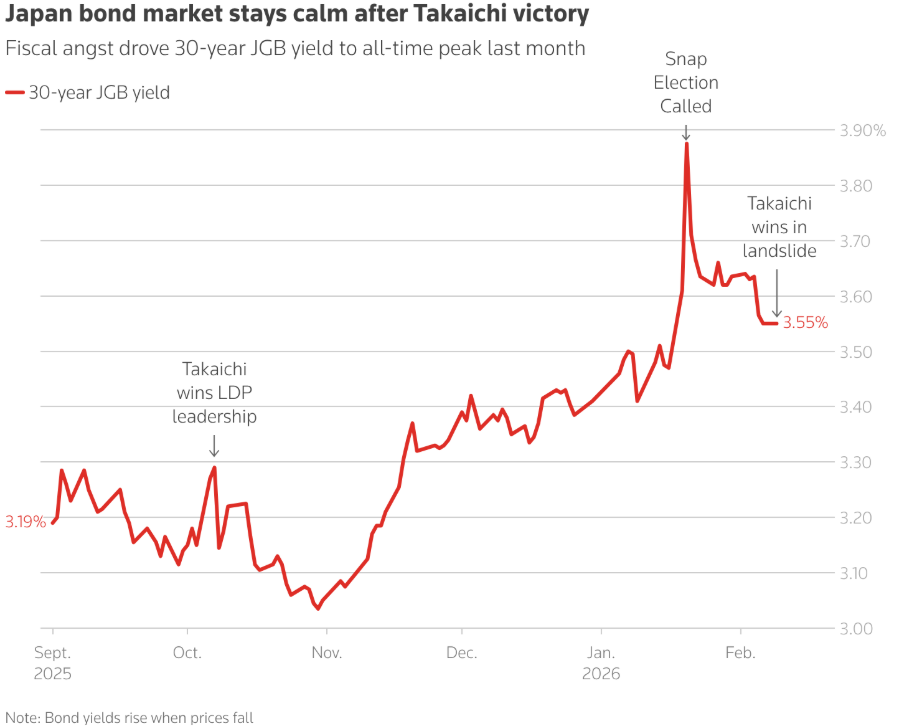
In the debt market, 30-year Japanese government bonds (JGBs) initially lurched lower, sending yields soaring 6.5 basis points (bps) to 3.615%. But that move was quickly unwound and the yield was last up just 1 bp at 3.56%.
“I think the reaction indicates that Takaichi has successfully convinced the market that she will be a strong leader, but not be a fiscally irresponsible one,” said Zuhair Khan, a senior portfolio manager at UBP.
“But we will have to wait and see.”
A bond investor revolt in October, when she won leadership of the LDP, provoked her to craft her current “responsible, proactive fiscal policy”, announced in her first policy speech to parliament and contained in the LDP’s manifesto.
From a policymaking perspective, Takaichi’s big win may be the best result for bond investors, because the LDP won’t need to compromise with opposition parties targeting even deeper tax relief and broader fiscal stimulus.
The 30-year JGB yield surged to a record 3.88% last month when Takaichi initially pledged to suspend the tax on food for two years, but has been well below that for the past two weeks. She has said that she won’t fill the estimated 10 trillion yen ($63.85 billion) shortfall with new bond issuance.
Shorter-dated JGB yields rose though, with the two-year yield up 3.5 bps to the highest since May 1996 at 1.31%, while the five-year yield climbed 5 bps to 1.735%, the highest according to LSEG figures dating back to April 2001.