























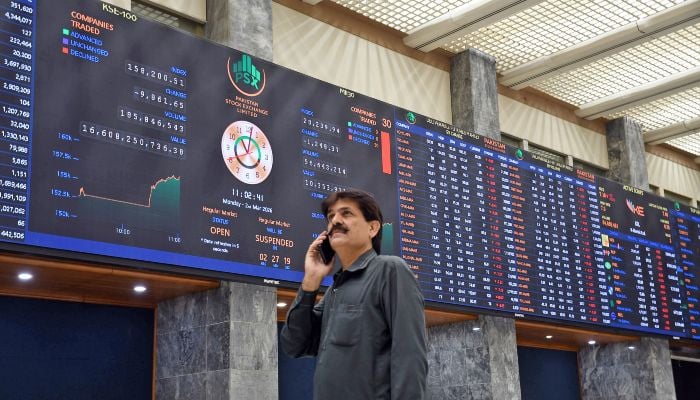
ISLAMABAD: The benchmark index at the Pakistan Stock Exchange (PSX) closed lower on Friday as rising global oil prices and tightening shipping conditions dampened investor sentiment, while investors remained cautious ahead of the upcoming monetary policy decision by the State Bank of Pakistan (SBP).

The KSE-100 Index settled at 157,496.1 points, declining 3,714.57 points or 2.3% from the previous close of 161,210.67.During the trading session, the index reached a high of 161,435.83 points, up 225.16 points (0.14%), and recorded a low of 157,072.64 points, down 4,138.03 points (2.57%).
Market analysts attributed the decline to external economic pressures and investor caution.“The market remained under pressure amid rising global oil prices and tightening shipping constraints in the post-war environment, which dampened investor sentiment,” said Huzaifa Riaz, Director at Mayari Securities (Pvt) Limited.He added that investors adopted a wait-and-see approach ahead of the upcoming monetary policy announcement, which kept activity cautious.
According to a market review by Topline Securities, investors turned sceptical after Thursday’s strong rally and opted to reduce exposure ahead of the weekend as fears grew that the US-Iran conflict could turn into a prolonged war.
The report noted that the biggest negative contribution to the index came from UBL, ENGROH, FFC, LUCK, HUBC, MEBL, SYS, OGDC and BAFL, which collectively dragged the index down by 2,124 points.In terms of trading activity, the most actively traded stocks by value included PPL (Rs1.83 billion), OGDC (Rs1.66 billion), ATRL (Rs1.62 billion), UBL (Rs1.16 billion) and NBP (Rs980 million). Total traded volume reached 360 million shares, with an overall value of Rs23 billion.
Adding to the caution, the central bank is expected to hold its policy rate steady at 10.5% at a review scheduled for Monday, according to a Reuters poll, as higher energy prices and regional tensions cloud the inflation outlook and limit the room for further cuts.
All 10 analysts surveyed expected no change after policymakers also held rates in January. Since mid-2024, the central bank has cut the key rate by a cumulative 11.5 percentage points from a record 22%.Analysts warned that the energy shock could keep inflation elevated. AKD Securities analyst Muhammad Aliv said energy prices would dictate the future path of interest rates and inflation could average around 7% during the second half of FY26.
JS Capital Head of Research Waqas Ghani said higher oil prices widen the trade deficit and put pressure on the rupee, adding that every $10 per barrel increase in crude typically adds about 0.5 percentage points to inflation. He noted that inflation rose to 7% in February from 5.8% in January.In the previous session on Thursday, the KSE-100 surged 5,433.46 points (3.49%) to close at 161,210.68 from 155,777.21 after trading between 161,476.85 and 156,250.29.