








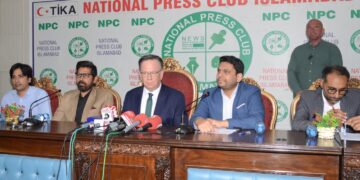
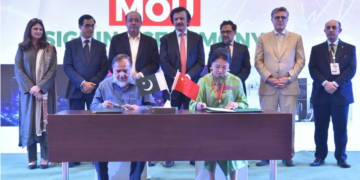
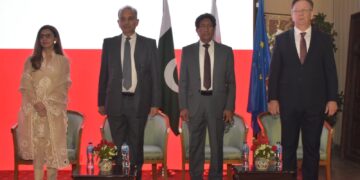
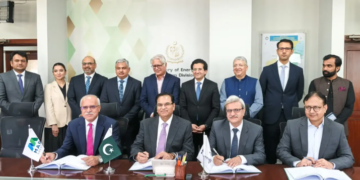

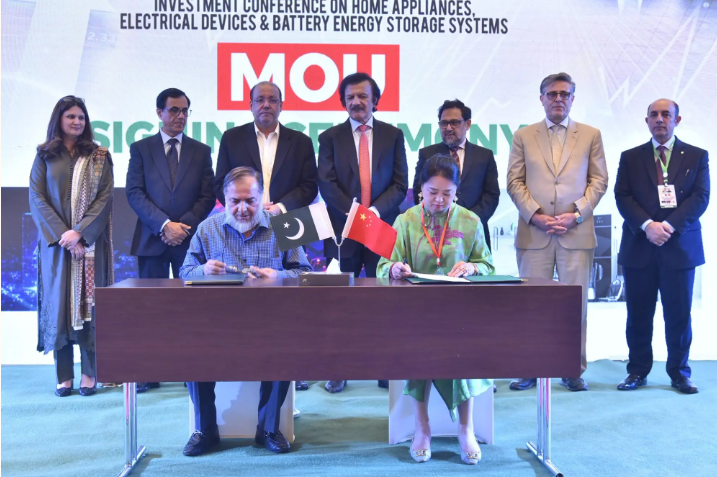
A business matchmaking session held during the Pakistan-China B2B Conference in Lahore concluded with the signing of dozens of Memoranda of Understanding (MoUs) worth millions of dollars between Pakistani and Chinese companies.

The conference featured participation from 74 Chinese firms represented by 105 delegates, while 136 Pakistani companies sent 252 representatives from major industrial and commercial sectors.
Significant agreements were reached across several industries. The home appliance sector recorded 15 MoUs, with the largest agreement valued at $40 million. In the electrical industry, 10 MoUs were signed, including one worth $60 million.
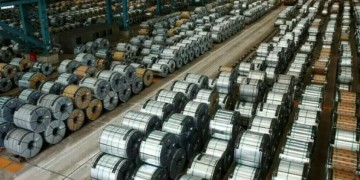
The battery storage sector stood out as the biggest area of cooperation, securing 27 MoUs, with the highest-valued agreement reaching $82 million. More than 40 additional MoUs and investment proposals are also under discussion.
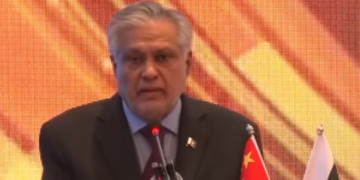
Speaking earlier at the event, Special Assistant to the Prime Minister on Industries and Production Haroon Akhtar Khan said Pakistan-China ties are rooted in trust, continuity, and a common vision. He noted that growing business-to-business engagement between the two countries is creating fresh economic opportunities.
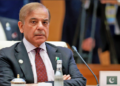
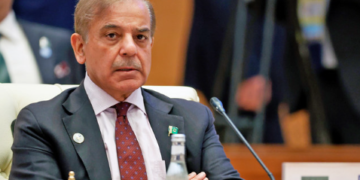
He said the outcomes of Prime Minister Shehbaz Sharif’s visit to China last year are beginning to show results, while Chinese investor confidence in Pakistan continues to grow.
Haroon Akhtar stated that Pakistan is becoming an attractive investment destination and that the government is implementing measures to support industrial development, expand exports, and improve the business environment. He added that reforms under the National Industrial Policy and National Tariff Policy are aimed at lowering business costs.
He also said unnecessary regulations are being eliminated through the Regulatory Guillotine initiative to create a more business-friendly economy. According to him, dedicated committees have been formed to ensure implementation and follow-up of every MoU and joint venture agreement.
The SAPM described Pakistan-China economic cooperation as a key driver of prosperity and development for both countries and urged Chinese investors to explore opportunities in manufacturing, technology, and energy.
Calling the conference a milestone in bilateral economic ties, he said it represented “a defining moment for shaping the future of Pakistan-China cooperation,” adding that strong participation reflected increasing confidence in Pakistan’s economic trajectory.
Haroon Akhtar further said the next phase of cooperation would focus on industrial expansion and technological integration. He credited Prime Minister Shehbaz Sharif’s leadership for stabilising the economy, restoring investor confidence, and improving Pakistan’s global credibility.
He emphasised that industrial revival remains central to the government’s economic strategy and said Pakistan aims to emerge not only as a consumer market but also as a manufacturing and technology partner. He identified home appliances, electrical equipment, and battery storage systems as future growth sectors, highlighting Pakistan’s young workforce and strategic location as key advantages.
Discussing the global transition toward electrification and clean energy, he said Pakistan, with Chinese collaboration, has the potential to become a regional centre for battery manufacturing and energy storage. He added that the country is prepared to play an active role in lithium-ion and sodium-ion battery technologies.
“Pakistan is ready to build, innovate, compete, and lead. Our doors are open, our direction is clear, and our commitment is strong,” he remarked.