























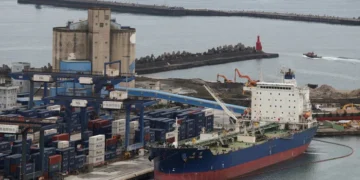




SINGAPORE: Oil prices jumped nearly 20% in early trading on Monday, reaching their highest level since July 2022, as the expanding US-Israeli conflict with Iran raised fears of prolonged supply disruptions and shipping risks in the Strait of Hormuz.

Concerns have intensified after several major Middle Eastern producers began cutting supplies, fuelling market worries about potential long-term disruption to global oil flows.
Analysts from BMI said their base-case outlook assumes the conflict in Iran will be significant but relatively short-lived, although the possibility of a prolonged war remains.
“Our baseline scenario is that the conflict in Iran will be large but short-lived, though there is a clear risk of a prolonged war. Among emerging markets, the economic impact will be most pronounced in the Gulf Cooperation Council, reflecting the shock’s adverse effects on trade, logistics, tourism, and investment.
“First, Pakistan and India are most vulnerable as they are energy importers with relatively high exposure to the Strait of Hormuz. Second, outside of physical trade disruption, Egypt and Turkey are most exposed. This is due to their high energy import bill, fragile external positions, large energy subsidies, and unanchored inflation. Third, commodity-producing economies in Sub-Saharan Africa and Latin America are least at risk, including Nigeria, Ghana, and Peru.”
Market analysts said supply-side pressures are also contributing to the price rally.
Daniel Hynes said oil prices surged after reports that Middle Eastern producers were cutting output due to rapidly filling storage facilities.
“I think prices have rallied this morning on the reports that Middle East producers are now reducing output due to storage facilities filling up fast.
“I certainly think the spectre now of Middle Eastern producers curtailing output is going to keep those prices elevated. The next flag will be whether it eventually reaches a point where they have to start shutting in oil wells, which not only further impacts output but also delays a response once the conflict eases. That would potentially sustain those prices for much longer.”
Vishnu Varathan said the effects of a supply shock would extend well beyond direct oil import costs.
“A sudden supply shock reverberates well beyond just who is a net energy exporter and importer. There are acute supply chain effects beyond price, eating into margins.
Even in places like Indonesia, where it is not unusual to see street protests when pump prices go up. “Asia takes the brunt of the sharp escalation in oil prices, and there are few places to run and hide.
The dollar has to be the one outperforming, given Japan and Korea’s exposures here and the sharp pain that can be expected from Brent at $107.“
Energy analysts say the market had previously underestimated the potential scale of disruption.
Saul Kavonic said investors had grown complacent about geopolitical risks after several years of tensions failed to significantly disrupt supply.
“The market had been complacent about the scope and duration of the war and associated supply disruptions until last Friday. “It’s a case of the oil market that cried wolf. After three years of geopolitical risk premia rising only to fail to translate to supply disruptions, the market became complacent about the current events. “But this existential Iran war is the energy crisis scenario that has been wargamed for 50 years, finally coming to the fore.”
Analysts also warned that potential attacks on refining infrastructure could severely affect the global economy.
Michael McCarthy said such threats could lead to a dangerous economic combination of slowing growth and rising inflation.
“The threats to attack refineries are very concerning. Because it threatens the worst of all economic worlds. Cutting off 15%-20% of the world’s oil supply not only slows down every economy globally, but it also introduces an inflation impulse. And inflation plus slowing growth is stagflation, and that’s an economic disaster.”
Oil market specialists say prices could rise further if disruptions in the Strait of Hormuz continue.
Muyu Xu said growing pessimism about a quick resolution is intensifying market fears.
“Oil prices have now gathered all the ingredients for a perfect storm… All compounded by a growing pessimism about a quick turnaround in the current situation.
“Now that the conflict has dragged into a second week and official/company statements increasingly point to preparations for a prolonged supply disruption, fears in the market are only intensifying, providing sustained support for oil prices. If the disruption in the Strait of Hormuz persists for another one to two weeks, we could see prices move toward $130–150/bbl.”
Meanwhile, analysts say markets see little immediate path to de-escalation.
Tony Sycamore said the sharp market reaction reflects growing concern that the conflict could escalate further.
“The violent reaction stems from the markets seeing no obvious offramp in the escalating Middle East conflict, now a high-stakes standoff where neither side appears willing to blink first. The risk of more lasting economic damage continues to build by the day.
“(US) President Donald Trump has kept the aggressive rhetoric flowing, at times demanding unconditional surrender in the hope that unrelenting pressure will splinter the regime’s inner circle or prompt pragmatic concessions from elements within the IRGC. He also posted this morning that the oil spike is likely temporary describing it as ‘a very small price to pay for the US and World Safety and Peace.’ While that may hold true longer-term, no clear timeline has emerged.”