

























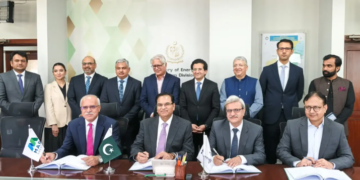


The Competition Commission of Pakistan (CCP) has published a report titled “Competition Assessment Study of the Cement Sector in Pakistan,” highlighting key competition-related issues in the cement industry and offering recommendations to enhance efficiency and promote fair competition.

Pakistan’s manufacturing sector continues to be a major pillar of the economy, with Large-Scale Manufacturing (LSM) accounting for about 67.5% of total manufacturing output and nearly 8% of GDP.
Within this sector, the cement industry holds significant importance, contributing roughly 1% to GDP and acting as a critical input for infrastructure and housing—both essential for long-term economic growth.
However, the industry has recently faced a slowdown. In FY2025, domestic cement consumption fell in both northern and southern regions, reflecting wider macroeconomic challenges and reduced construction activity. The report also points out that Pakistan’s per capita cement usage remains well below the global average, suggesting strong untapped growth potential.
The study highlights several structural, regulatory, and strategic hurdles that limit competition and distort market dynamics.
Structural challenges include high capital requirements, water shortages in mineral-rich areas, cement’s limited shelf life, expensive transportation, and seasonal demand variations—all of which make market entry and expansion difficult.
These issues are worsened by regulatory and policy-related distortions such as inconsistent enforcement of axle-load limits across provinces, variations in provincial limestone royalty rates, reliance on a single coal-handling terminal at the port, and a complex tax structure. Additionally, recent fuel levies on captive power plants have raised energy costs, reducing efficiency.
The report also notes that weak border controls allow smuggling and the spread of counterfeit cement, which harms compliant producers, compromises quality and safety, and leads to revenue losses.
To address these concerns, the report outlines a comprehensive reform plan aimed at improving competition and removing barriers to entry and growth in the cement sector.
It stresses the importance of developing the mineral sector to support new cement capacity and unlock long-term growth.
The report calls for uniform enforcement of axle-load regulations nationwide, along with modernized logistics systems to improve transport efficiency and reduce cost disparities.
It also recommends standardizing provincial limestone royalty systems through a transparent and predictable framework to ensure fair competition.
Encouraging competition in coal-handling infrastructure at ports is another key proposal, aimed at reducing dependence on limited facilities and improving operational efficiency.
To boost investor confidence, the report emphasizes the need for a stable, medium-term tax policy framework.
Finally, it suggests rationalizing energy pricing through cost-reflective tariffs and time-of-use mechanisms to enhance efficiency and better manage production costs.