


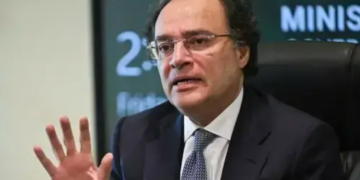





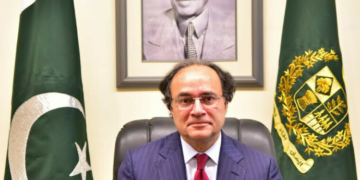







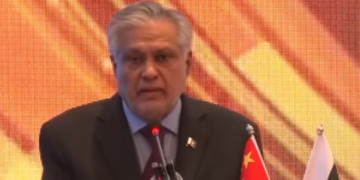




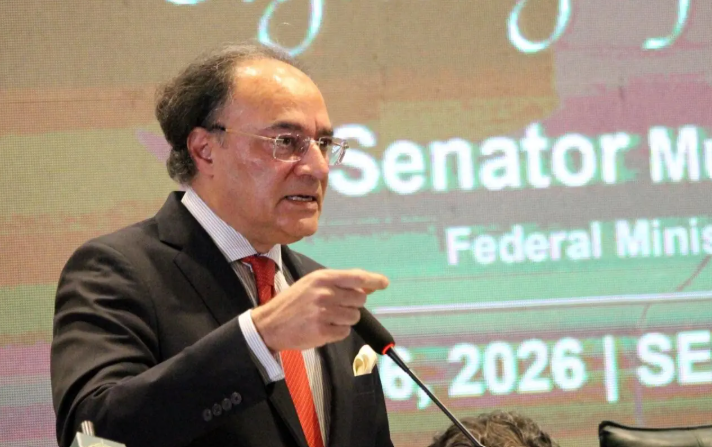
Finance Minister Muhammad Aurangzeb said Pakistan has ample internal resources to support investment and economic growth, emphasizing that local investors will be central to financing key sectors as the country strengthens its capital markets to unlock long-term funding.

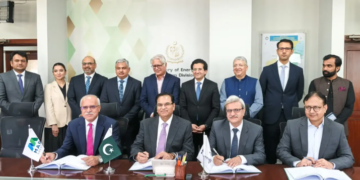
Speaking at the Capital Market Development Fund (CMDF) signing ceremony organized by the Securities and Exchange Commission of Pakistan in Islamabad, the minister noted that Pakistan’s mediation efforts are gaining momentum.
“We have seen one positive development overnight, and we are hopeful that the conflict will end at the earliest. It’s the right thing for the world, our region, and our country.”
He stressed that with sufficient domestic resources available for rescue, relief, reconstruction, and rehabilitation, reliance on external countries or multilateral institutions can be reduced. “That is the strength we are referring to when we talk about ‘Pakistan First’,” he said.
Aurangzeb highlighted the government’s increasing focus on mobilizing indigenous capital as part of a broader national security strategy, adding that capital markets will play a critical role in this shift.
Addressing concerns about the government crowding out private sector activity, he said there is a need to expand into Sukuks and further develop capital markets.
On equities, the minister said that despite recent volatility—largely driven by geopolitical tensions in recent weeks—the fundamentals remain solid.
More than 220,000 new investors have entered the market over the past two years, mainly driven by young participants using digital platforms.
“In April alone, around 24,000 new investors joined the market, the highest ever in a single month. So from the equity stand, we are indeed moving in the right direction.”
“However, in the debt capital market, we have actually gone in reverse gear,” he said.
Aurangzeb underscored the need to strengthen the corporate bond market and improve regulatory frameworks, ease of doing business, and taxation policies in coordination with the Ministry of Finance and the FBR.
On investor education, he emphasized that programs should be tailored to the current wave of younger investors rather than older demographics.
He added that regulators like the SECP must ensure a balance between market growth, investor protection, and fiscal discipline.
Discussing privatization, Aurangzeb said meaningful progress is underway, citing the example of Pakistan International Airlines, where bids worth around $1.2 billion reflect strong domestic investor capacity.
While foreign investment remains welcome, he reiterated that local resources are robust enough to drive growth independently.
He also shared that additional privatization plans, including in the power distribution sector and financial institutions, are being prepared, alongside efforts to streamline public-private partnerships.
“All of this makes capital markets even more critical going forward,” he said.