



















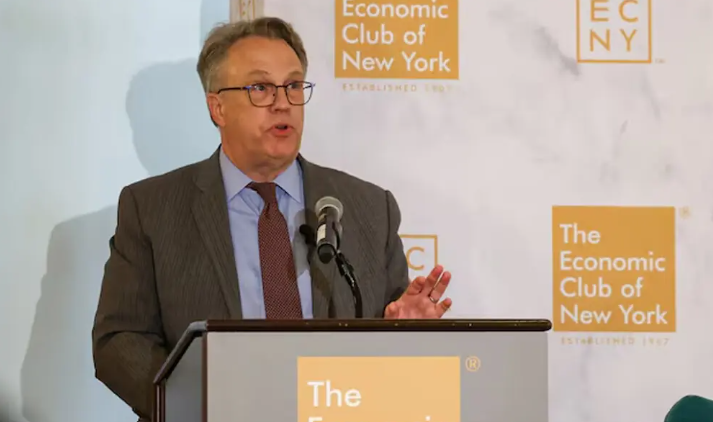
Federal Reserve Bank of New York President John Williams said on Tuesday that the energy shock from the Middle East conflict will lift overall inflation this year, while emphasizing that current monetary policy remains appropriate for economic conditions in the United States.

The impact of the war “will directly go into headline inflation because energy prices are an important component of that,” Williams said in an interview on Bloomberg Television. “I expect headline inflation to actually be elevated, you know, in the middle of this year” and come in at around 2.75% for the year, he added.
In the short term, as the effects of the conflict—triggered by U.S.-Israeli strikes on Iran filter through the economy, Williams said inflation could exceed 3%, noting that financial markets are already anticipating such a scenario.
He added that while underlying inflation will also rise due to higher energy costs, the increase will be less pronounced.
“Overall, I’m kind of where I’ve been for a while, with core inflation around two and a half percent this year,” Williams said, referring to inflation excluding food and energy.
Williams reiterated that there is no immediate need to adjust monetary policy. The Federal Reserve’s benchmark interest rate currently stands in a range of 3.5% to 3.75%, with policymakers last month projecting one quarter-point rate cut later this year.
“Monetary policy today is really well positioned, given where all of those dynamics have been playing out, and well positioned to kind of wait and see on some of the effects of…what’s happening today,” Williams said. “I’m not saying we’re just, you know, in some kind of ‘we can’t act’” stance, instead, “I think this monetary policy is exactly where it needs to be.”
He noted that rising energy prices are likely to weigh on economic growth, as households allocate more spending toward fuel.
“I’ve been bringing down my forecast for growth this year, probably somewhere between two and two and a half percent for growth this year, and unemployment rate probably staying around where it is now,” he said.
Williams also downplayed concerns about leadership uncertainty at the central bank, including the potential confirmation of Kevin Warsh as Fed chair and the possibility of Jerome Powell remaining in the role longer.
“I would just highlight the most important thing here is that, you know, we’re just focused on doing our work. There’s no issue about continuity or things like that,” Williams said.