





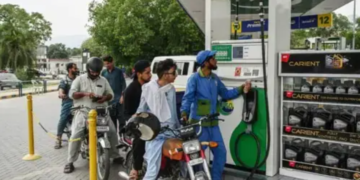












LAHORE: The Businessmen Panel (BMP) of the Federation of Pakistan Chambers of Commerce and Industry (FPCCI) has strongly criticised the government’s fuel taxation approach, cautioning that the sharp rise in petroleum prices is steering the economy toward stagnation and weakening industrial competitiveness.

BMP Chairman and former FPCCI President Mian Anjum Nisar stated that recent fuel price increases in Pakistan—ranging from 63% to over 75% for petrol and diesel—far exceed those in regional economies, where hikes have remained between 2% and 10%. He noted that countries such as India, Bangladesh, China, and Vietnam have adopted more measured pricing strategies, using subsidies, tax adjustments, and gradual changes to protect their industries, while Pakistan has placed a significantly heavier burden on its economy.
“This policy divergence is not just alarming—it is economically damaging,” he said. “At a time when our exporters are already struggling with high energy costs and declining global demand, such an excessive increase in fuel prices is effectively pricing Pakistan out of international markets.”
Mian Anjum Nisar pointed out that petrol prices nearing Rs458 per litre—largely due to a petroleum levy exceeding Rs160 per litre—reflect a fiscal strategy heavily dependent on indirect taxation. While acknowledging the limitations imposed by the IMF programme, he warned that overreliance on fuel taxes could suppress economic activity rather than stabilise finances.
“Fuel is the backbone of all economic sectors—transport, manufacturing, agriculture, and services. When its cost rises sharply, the entire economic chain is disrupted,” he explained. “This is not just a price increase; it is a structural shock.”
He highlighted that Pakistan already faces some of the highest logistics and transportation costs in the region, and further fuel price hikes will increase freight charges, raise production costs, and squeeze profit margins. Export-oriented industries, particularly textiles and value-added sectors, may face setbacks as global buyers turn to more cost-competitive markets.
“Our regional competitors are gaining ground precisely because their governments are protecting industry from such shocks,” he said. “Bangladesh and Vietnam, for example, continue to offer stable energy pricing, enabling their exporters to secure long-term contracts at competitive rates.”
The BMP chief also warned about the impact on small and medium enterprises (SMEs), noting that many lack the financial capacity to absorb sudden cost increases. “Unlike large corporations, SMEs do not have the financial cushion to absorb sudden cost increases. Many will be forced to scale down operations, reduce workforce, or shut down entirely,” he said.
He added that the agriculture sector will also be affected, as diesel-powered machinery such as tractors, tube wells, and harvesters becomes more expensive to operate. This could raise food production costs, fueling inflation and worsening food security concerns.
Mian Anjum Nisar also cautioned that excessive taxation may not generate the expected revenue. “There is a threshold beyond which increased taxation leads to reduced consumption and, ultimately, lower revenue collection. As economic activity slows, fuel demand declines, undermining the very fiscal objectives the government seeks to achieve,” he said.
He criticised the distortion caused by current pricing policies, including cross-subsidisation between petrol and diesel. “Such measures disrupt market signals and create inefficiencies. Instead of promoting rational consumption, they redistribute financial stress within an already fragile system,” he added.
On the social side, he warned that rising fuel prices disproportionately affect lower and middle-income groups, increasing transport fares, food costs, and utility expenses, thereby eroding purchasing power and intensifying economic hardship.
“This is not just an economic issue; it is a social challenge,” he said. “Persistent inflation and declining real incomes can lead to public discontent and instability.”
Mian Anjum Nisar urged the government to adopt a more balanced fiscal strategy, including reducing the petroleum development levy, rationalising energy tariffs, and providing targeted support to export sectors.
He emphasised that fiscal consolidation should prioritise cutting non-productive expenditure, improving efficiency, and strengthening fiscal discipline rather than relying heavily on revenue generation.
He also called for broadening the tax base by incorporating untaxed sectors such as retail and agriculture into the formal economy. “The burden cannot continue to fall on the already documented sectors. Structural reforms in taxation are essential for long-term sustainability,” he said.
Additionally, he stressed the need for energy sector reforms, including reducing transmission losses, curbing theft, and improving distribution efficiency, warning that without addressing these issues, price increases will continue to shift inefficiencies onto consumers and businesses.
He further recommended a gradual and predictable fuel pricing mechanism to prevent sudden shocks. “Gradual adjustments, combined with targeted subsidies for vulnerable groups, can help balance fiscal needs with economic stability,” he suggested.