


























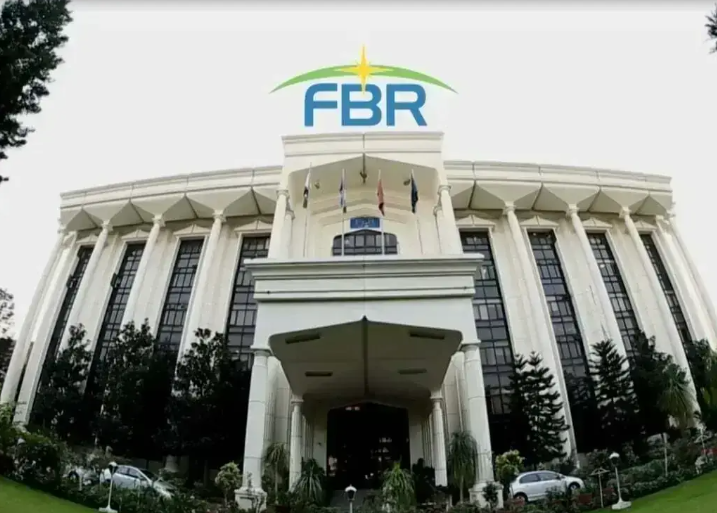
ISLAMABAD: The Federal Board of Revenue (FBR) has approached the Federal Constitutional Court (FCC), seeking enforcement of tax authorities’ powers under the Federal Excise Act, 2005, and the Federal Excise Rules, 2005.

The tax authority filed three separate petitions on Monday, requesting leave to appeal against a Peshawar High Court ruling dated December 18, 2025. The petitions were submitted through advocate Hafiz Ehsaan Ahmad Khokhar under Article 185 of the Constitution.
The case raises key questions about the scope of constitutional jurisdiction under Article 199 of the Constitution.
According to the petitions, tax officials, acting on credible information about possible evasion of federal excise duty, secured search warrants and carried out an operation on December 12, 2025, targeting three cigarette manufacturing units on Nowshera Road in Mardan.
The operation, supervised by an Assistant Commissioner, led to the recovery of around 2.75 million kilograms of unmanufactured tobacco from five warehouses located at Sang-e-Mar Mar on the Swabi-Mardan Road, opposite Samson GLT.
Authorities cited the absence of duty-paid documentation and discrepancies in stock records as grounds for forming a “reason to believe” under Rule 28A (6) of the Federal Excise Rules, 2005, that the goods were being held unlawfully and that the manufacturing units were operating in violation of the law.
As a result, the GLT unit and related manufacturing facilities were sealed under Rule 28A (6), read with Sections 26 and 27 of the Federal Excise Act, 2005. A show-cause notice was later issued under Sections 24 and 33 to initiate formal adjudication proceedings.
The affected companies challenged the action before the Peshawar High Court under Article 199. The court ruled in their favor, declaring the sealing of the units illegal, while allowing authorities to continue investigations and assessments in accordance with the law.
FBR argued that the High Court’s decision contradicts the established legal principle of exhausting available remedies before invoking constitutional jurisdiction, as affirmed in prior Supreme Court rulings.
The petitions further contend that the High Court intervened prematurely, as the case was still at the show-cause notice stage and no final liability had been determined.
FBR also challenged the court’s interpretation of the term “reason to believe,” asserting that it should be based on objective material available at the time of action rather than conclusive proof established later.
The department maintained that the recovery of a large quantity of unaccounted tobacco and lack of documentation justified regulatory action under the law.
It also argued that the High Court overstepped by substituting its own judgment for that of the competent authority, emphasizing that sealing the units was a preventive measure aimed at protecting government revenue, not a punitive action.