


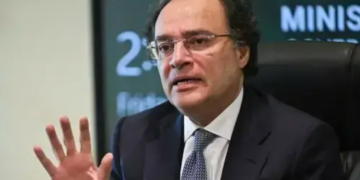




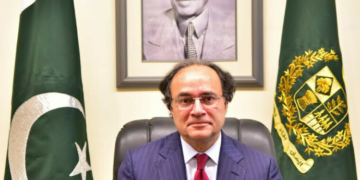









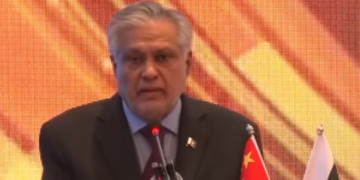
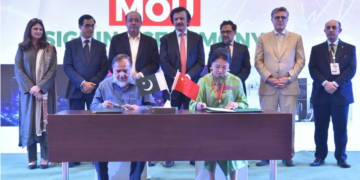
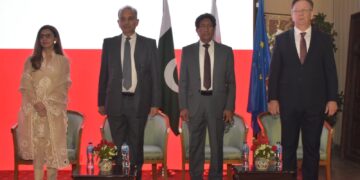

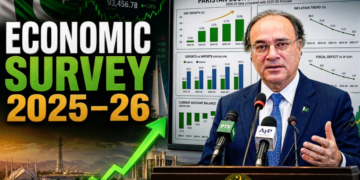
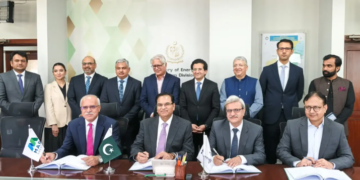

ISLAMABAD — Finance Minister Muhammad Aurangzeb has said that Pakistan has fulfilled most of the conditions set by the International Monetary Fund (IMF) and is optimistic about receiving the next USD 1.2 billion tranche following approval by the IMF Executive Board on May 8.

Speaking at the EU-Pakistan Business Forum, the finance minister said Pakistan’s economic reforms are broadly on track under the IMF programme, with the country targeting around 4% GDP growth amid improving macroeconomic stability.
He noted that the government is actively assessing risks from external shocks, including oil price volatility, freight disruptions, and inflationary pressures linked to regional geopolitical tensions, particularly in the Gulf.
Aurangzeb acknowledged that recent energy supply disruptions have added inflationary pressure, as also reflected in projections by the State Bank of Pakistan (SBP).
The minister said the staff-level agreement reached with the IMF on March 27 has largely been implemented, paving the way for approval of the third review under the Extended Fund Facility (EFF) and the second review under the Resilience and Sustainability Facility (RSF).
He added that IMF approval would unlock critical external inflows and help stabilise Pakistan’s balance of payments, while an IMF mission is expected in mid-May for discussions on the next fiscal year’s budget.
On fiscal performance, Aurangzeb said Pakistan has achieved both primary and overall fiscal surpluses, while economic growth is expected to approach 4% this fiscal year. He added that debt servicing costs are likely to remain below budgeted levels, creating additional fiscal space.
Regarding external accounts, he projected foreign exchange reserves to reach around USD 18 billion by June, despite significant repayments, including USD 3.5 billion to a bilateral partner and USD 1.4 billion in Eurobonds.
The minister also highlighted a shift in financing strategy away from reliance on bilateral inflows toward international capital markets, including Panda bonds, Eurobonds, and Sukuk. A USD 250 million Panda bond is expected to be launched in May, supported by guarantees from multilateral institutions such as the Asian Development Bank and the Asian Infrastructure Investment Bank.
Aurangzeb further said Pakistan is implementing a contributory pension scheme for the armed forces starting from the 2026–27 budget.
He added that remittances averaging USD 3.8 billion per month, rising inflows through Roshan Digital Accounts, and strong IT exports are supporting economic stability and growth momentum.
On debt management, he said the Debt Management Office has been restructured to improve oversight, while interest payments are expected to remain within budgeted limits.