






























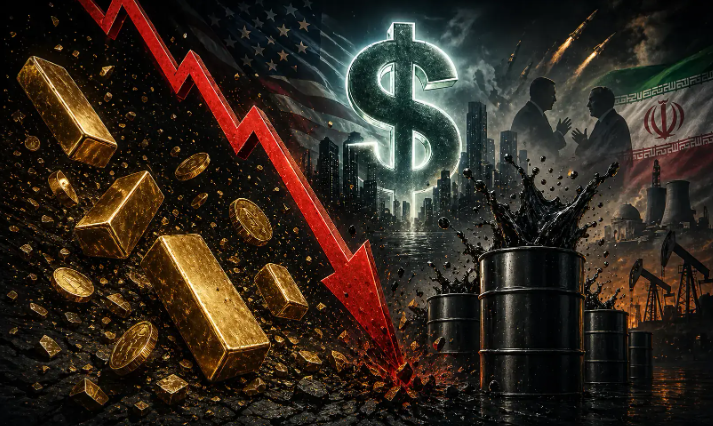
Gold prices edged lower on Tuesday as investors closely monitored developments in the Middle East conflict and stalled US-Iran negotiations, alongside upcoming decisions by major central banks.

Spot gold dipped 0.2% to $4,670.89 per ounce as of 0350 GMT, while US gold futures for June delivery also declined 0.2% to $4,684.70.
Sentiment remained influenced by tensions involving Donald Trump, who is reportedly dissatisfied with Iran’s latest proposal to end the ongoing conflict. The continued deadlock has disrupted energy supplies, driven inflation concerns, and added uncertainty to global markets.
Edward Meir, an analyst at Marex, said geopolitical developments remain the primary driver of gold prices. He noted that any agreement between the US and Iran could weaken the dollar and push gold higher.
Meanwhile, the dollar firmed slightly, and oil prices stayed elevated above $109 per barrel, with the Strait of Hormuz still largely closed. Higher oil prices tend to fuel inflation by increasing transportation and production costs, which can lead to tighter monetary policy.
Although gold is often seen as a hedge against inflation, higher interest rates reduce its appeal by making yield-bearing assets more attractive.
The Federal Reserve is widely expected to keep interest rates unchanged at the conclusion of its two-day meeting on Wednesday.
Meir suggested the Fed is unlikely to act in the near term, but added that rate cuts could come later in the fourth quarter as the global economy slows.
Investors are also watching policy decisions from other major central banks this week, including the European Central Bank, the Bank of England, and the Bank of Canada.
In other precious metals, spot silver fell 1.2% to $74.61 per ounce, platinum held steady at $1,984.19, and palladium declined 0.9% to $1,463.