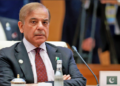


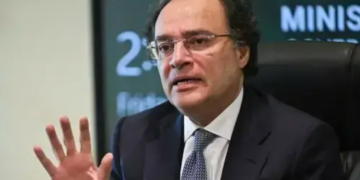



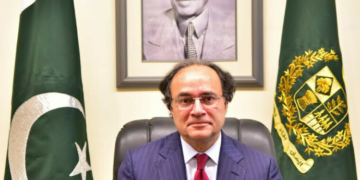






Finance Minister Muhammad Aurangzeb has cautioned that any prolonged escalation in Middle East tensions—especially disruptions to energy supply routes—could significantly impact inflation, fuel availability, and overall economic stability in Pakistan, given the country’s reliance on imported energy and limited reserve capacity.

In an interview with CNBC, Aurangzeb said Pakistan is closely observing developments surrounding the ongoing discussions between the United States and Iran.
“All I can say is that diplomacy is a process, not an event,” he said.
“So our leadership is still at it, and a very earnest effort was made over the weekend, and that was recognised both by the US leadership and the Iranian leadership. So at this point, the discussions continue.”
The talks are being seen as the most significant engagement between Washington and Tehran in decades, highlighting that while progress may be gradual, sustained dialogue itself is a meaningful step forward.
Commenting on Pakistan’s role, Aurangzeb said the country continues to support efforts that promote engagement. “We have to be hopeful because dialogue and diplomacy is the way forward. Even as a country, which is not directly involved in the war, but we are in a war-like situation,” he said.
He also pointed to rising concerns about the broader economic consequences of continued instability.
“The first order impact that we see in our country, in terms of the molecule availability, the pricing, the price transmission, and then the second order impact, if there is longevity in this [conflict] and the duration, intensity goes forward, the second and the third order impact would be quite a big issue for the entire world, but certainly for us as well,” he said.
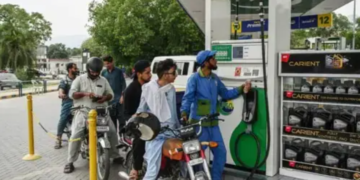
Aurangzeb further emphasized Pakistan’s heavy dependence on Middle Eastern energy imports—including crude oil, gas, diesel, aviation fuel, and LPG—making regional stability critical for economic management.
“Our reserves are good enough to take us to the end of this month into next month as well. But as a country which is built on commercial reserves and we do not have strategic reserves, both the availability and the pricing become a real issue,” he said.