







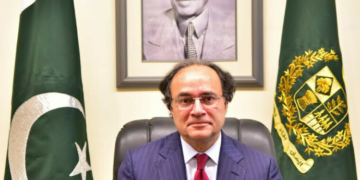
















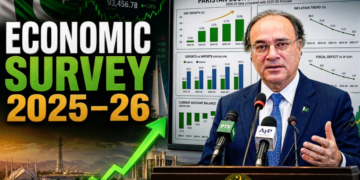




Finance Minister Muhammad Aurangzeb on Monday said the government plans to gradually reduce its dependence on commercial banks for financing by expanding access to government securities through digital investment platforms.

Speaking at the launch of the State Bank of Pakistan’s InvestPak Portal, Aurangzeb described the initiative as the “beginning of a new era of investment”.
The State Bank introduced the InvestPak Portal as a digital platform aimed at simplifying and digitising investment in government securities for both individual and corporate investors.
Aurangzeb said expanding and diversifying the government’s investor base remained a major policy priority alongside advancing Pakistan’s digital transformation.
“From the government’s perspective, is diversification,” he said.
The finance minister said he had recently met with bank chief executives to discuss increasing credit flows to the private sector, while acknowledging concerns over the government’s heavy borrowing from commercial banks.
“One issue that always comes up is whether the government borrows too much and whether there is a crowding-out impact. There may be some aspect to that as well,” Aurangzeb said. Therefore, the government wanted to diversify its funding sources “away from” the commercial banks.
“The more we diversify away from the banks… and especially those of you sitting here from the NBFI industry. I think it’s about time that you now step up,” he said.
“It makes sense from your business models and asset-liability management (ALM) models that you also start thinking about how you can get into this discussion and help.”
Aurangzeb said Pakistan’s reliance on the banking sector to finance government borrowing remained excessive, adding that broadening the investor base would enable banks to play a greater role in supporting private-sector lending.
“We have too much reliance on the banking sector for government borrowing. Over a period of time, we need to diversify so that the banks have the capacity and the willingness to actually come in and do what they need to do in terms of the private-sector lending,” he said.
He also highlighted technology as a key driver of financial inclusion, saying digital platforms could make investing “faster, cheaper and better” while democratizing access to investment.
The finance minister noted that equity market participation had grown significantly over the past 12 to 18 months but said investment in fixed-income instruments had lagged behind.
“While we have seen encouraging growth in equity investments, we have lagged in the fixed-income segment. This initiative will help move us in the right direction.”